
An Nd: YAG electro-optic Q-switched laser side-pumped by a laser diode and its extra-cavity frequency-doubling characteristics are reported in this paper. The laser employs a KD*P crystal as the electro-optic Q-switch and uses a combination of a 1/4 wave plate and a polarizer to achieve precise Q-switch control. Under the operating conditions of the pump power of 80W, the 1064 nm laser output with a pulse width of 10ns and a single-pulse energy of 3µJ was obtained, with a peak power of 300W. By inserting a 15mm long KTP frequency-doubling crystal outside the cavity, a 532nm single-pulse green of 1.75µJ was achieved with a frequency-doubling conversion efficiency of 58.3%. This experiment achieved high peak power pulsed output from an all-solid-state electro-optic Q-switched laser, with excellent pulse stability and energy fluctuations of less than ±1%. The results demonstrate that the KD*P crystal, as an electro-optic Q-switch, enables precise Q-switching control and generates laser output with narrow pulse width. Furthermore, the frequency-doubling crystal KTP is highly suitable for frequency doubling 1064nm laser radiation, achieving high conversion efficiency at moderate power densities. This study also effectively addressed potential thermal effects during laser operation by implementing a water-cooling system and optimized heat sink design, which successfully controlled the temperature of the Nd: YAG crystal, KD*P electro-optic crystal, and KTP frequency-doubling crystal.
| Published in | Optics (Volume 13, Issue 2) |
| DOI | 10.11648/j.optics.20251302.13 |
| Page(s) | 33-37 |
| Creative Commons |
This is an Open Access article, distributed under the terms of the Creative Commons Attribution 4.0 International License (http://creativecommons.org/licenses/by/4.0/), which permits unrestricted use, distribution and reproduction in any medium or format, provided the original work is properly cited. |
| Copyright |
Copyright © The Author(s), 2025. Published by Science Publishing Group |
Side-pumping, Electro-optic Q-switching, Nd: YAG Laser, Extra-cavity Frequency-doubling, KTP Crystal
LD | Diode Laser |
DPSSL | Diode Laser Pumped Solid-state Lasers |
SHG | Second Harmonic Generation |
| [1] | Eli Jorge da Cruz Junior, Francisco Mateus Faria de Almeida Varasquim, Vicente Afonso Ventrella, Irene Calliari, Claudio Gennari, Bruna Berbel Seloto, Andrea Zambon, Alessio Giorgio Settimi, “Influence of cobalt addition in the fusion zone of duplex stainless steel welded with pulsed Nd: YAG laser,” Welding in the World, 69, 1941-1948 (2025). |
| [2] | Qing Cai, Li Meng, Xiaoping Liu, Zhiqin Gao, Hongjin Ren, Jingwen Tan, Lianjuan Yang, “A randomised comparative study of 1064 nm Nd: YAG laser and Urea occlusion therapy with topical miconazole for the treatment of onychomycosis,” Lasers in Medical Science, 40, 213 (2025). |
| [3] | Mohamed Salaheldien Alayat, Nahla Ahmad Almatrafi, Ehab Mohamed Abd El‑Kafy, Reem Mohammed Basuodan, Halah Yaser Gari, “Efficacy of pulsed Nd: YAG laser on forearm skin temperature and electrophysiology in normal subjects: a case‑control study,” Journal of Thermal Analysis and Calorimetry, 149, 9307-9314 (2024). |
| [4] | Alessandra Fusco, Vittoria Savio, Brunella Perfetto, Maria Donniacuo, Elena Shadrina, Giovanna Donnarumma, Adone Baroni, “Q‑switched Nd: YAG laser protects human keratinocytes from oxidative stress and inflammation via AhR–Nrf2 pathway,” Lasers in Medical Science, 39, 7 (2024). |
| [5] | Tom Bolderman, Noud Maes, Nico Dam, “Nitric oxide laser‑induced fluorescence using the fifth harmonic of a broad‑band Nd: YAG laser,” Applied Physics B, 130, 148 (2024). |
| [6] | I. Sivagami, R. O. M. U. Jauhar, T. Sivanesan, Paavai. Era, R. Ranjani, Twana Mohammed Kak Anwer, Shaik Hasane Ahammad, Md. Amzad Hossain, Ahmed Nabih Zaki Rashed, “Determination of Optical, Photoluminescence, Structural, Spectral, Laser Damage and Thermal Properties of an Organic Methylammonium Hydrogen Succinate Monohydrate Single Crystal (MHSM),” Journal of Electronic Materials, 52, 4717-4728 (2023). |
| [7] | Yong Chan Cho, Sooheyong Lee, Lei Wang, Yun-Hee Lee, Seongheun Kim, Hyun-Hwi Lee, John Jonghyun Lee, Geun Woo Lee, “Impact of molecular symmetry on crystallization pathways in highly supersaturated KH2PO4 solutions,” Nature Communications, 15, 3117 (2024). |
| [8] | K. Jeyapappa, P. Selvarajan, “Investigation of the Spectral, Hardness, Second‑Order NLO and Electrical Characteristics of L‑Arginine Hydrobromide Monohydrate Crystals for Laser Technology,” Journal of Electronic Materials, 53, 2946-2954 (2024). |
| [9] | Zhixin Sun, Zhen Fan, Guangyong Jin, Chao Xin, “The Structural and Optical Properties of Mn/Fe‑Doped KDP Crystals: A First‑Principles Calculation,” Journal of Electronic Materials, 53, 891-898 (2024). |
| [10] | Vinh Trung Phan, Vung Thanh Nguyen, Bao Le Quoc Nguyen, “Structural, vibrational, optical and second harmonic generation studies of urea doped single KDP crystals grown by Sankaranarayanan–Ramasamy technique,” Optical and Quantum Electronics, 56, 70 (2024). |
| [11] | T. Mondal, S. Das, “Study of third‑order nonlinear optical properties of APB inorganic single crystal with a Q‑switched Nd‑YAG laser under 532 nm and 1064 nm excitation wavelengths,” Journal of Materials Science: Materials in Electronics, 35, 2272 (2024). |
| [12] | Fan Jing-jing, “Research on LD pulse side-pumped Nd: YAG/LBO extra-cavity frequency-doubled electro-optic Q-switched green laser,” Master's Thesis, Northwest University, China, 47-50 (2010). |
| [13] | Lianju Shang, Zhenzhong Cao, Hui Xu, Mingsheng Niu, “An Intracavity Frequency Doubled Nd: YVO4 Red 671nm Laser Based on LBO Crystal,” Optics, 8(2), 7-10 (2019). |
| [14] | L. Shang, Z. Cao, X. Yang, “A passively Q-switched Yb3+-doped all-fiber laser based on SBS effect,” Optoelectronics and Advanced Materials - Rapid Communications, 10(5-6), 314-316 (2016). |
| [15] | L. Shang, J. Ning, X. Yang, “An experimental study of an acousto-optic Q-switched Yb3+-doped all-fiber laser,” Optik, 123, 1061-1062 (2012). |
| [16] | Shang Lian-Ju, Ning Ji-Ping, “1.34µm Nd: YVO4 high efficiency laser end-pumped by diode-laser of flat-concave cavity type,” Chinese Physics, 14(7), 1387-1391 (2005). |
| [17] | L. J. Shang, J. P. Ning, G. F. Fan, Z. Q. Chen, Q. Han, H. Y. Zhang, “Experimental study of ytterbium-doped double-clad all-fiber laser at 1083 nm,” Journal of Optoelectronics and Advanced Materials, 9(8), 2354-2355 (2007). |
| [18] | Lianju Shang, Jiping Ning, Zhenzhong Cao, Guofang Fan, Zhiqiang Chen, Qun Han, Huayong Zhang, “Factors that influence peak power of Q-switched fiber laser,” Modern Physics Letters B, 21(14), 843-850 (2007). |
| [19] | L. J. Shang, J. P. Ning, G. F. Fan, Z. Q. Chen, Q. Han, H. Y. Zhang, “Effective methods to improve pulse energy of Q-switched fiber laser,” Journal of Optoelectronics and Advanced Materials, 8(3), 1254-1257 (2006). |
| [20] | L. J. Shang, J. P. Ning, G. F. Fan, Z. Q. Chen, Q. Han, H. Y. Zhang, “Effective methods to narrow pulse width of Q-switched fiber laser,” Journal of Optoelectronics and Advanced Materials, 8(2), 851-854 (2006). |
| [21] | Lianju Shang, Hui Xu, Zhenzhong Cao, Mingsheng Niu, “A Hybrid Q-switched Yb3+-doped All-fiber Laser Based on the Acousto-optic Q-switch and SBS Effect,” Advances in Materials, 8(4), 166-169 (2019). |
APA Style
Shang, L., Cao, Z. (2025). LD-pumped Nd: YAG Electro-optic Q-switched Laser and Its KTP Extra-cavity Frequency-doubling Characteristics. Optics, 13(2), 33-37. https://doi.org/10.11648/j.optics.20251302.13
ACS Style
Shang, L.; Cao, Z. LD-pumped Nd: YAG Electro-optic Q-switched Laser and Its KTP Extra-cavity Frequency-doubling Characteristics. Optics. 2025, 13(2), 33-37. doi: 10.11648/j.optics.20251302.13
AMA Style
Shang L, Cao Z. LD-pumped Nd: YAG Electro-optic Q-switched Laser and Its KTP Extra-cavity Frequency-doubling Characteristics. Optics. 2025;13(2):33-37. doi: 10.11648/j.optics.20251302.13
@article{10.11648/j.optics.20251302.13,
  author = {Lianju Shang and Zhenzhong Cao},
  title = {LD-pumped Nd: YAG Electro-optic Q-switched Laser and Its KTP Extra-cavity Frequency-doubling Characteristics},
  journal = {Optics},
  volume = {13},
  number = {2},
  pages = {33-37},
  doi = {10.11648/j.optics.20251302.13},
  url = {https://doi.org/10.11648/j.optics.20251302.13},
  eprint = {https://article.sciencepublishinggroup.com/pdf/10.11648.j.optics.20251302.13},
  abstract = {An Nd: YAG electro-optic Q-switched laser side-pumped by a laser diode and its extra-cavity frequency-doubling characteristics are reported in this paper. The laser employs a KD*P crystal as the electro-optic Q-switch and uses a combination of a 1/4 wave plate and a polarizer to achieve precise Q-switch control. Under the operating conditions of the pump power of 80W, the 1064 nm laser output with a pulse width of 10ns and a single-pulse energy of 3µJ was obtained, with a peak power of 300W. By inserting a 15mm long KTP frequency-doubling crystal outside the cavity, a 532nm single-pulse green of 1.75µJ was achieved with a frequency-doubling conversion efficiency of 58.3%. This experiment achieved high peak power pulsed output from an all-solid-state electro-optic Q-switched laser, with excellent pulse stability and energy fluctuations of less than ±1%. The results demonstrate that the KD*P crystal, as an electro-optic Q-switch, enables precise Q-switching control and generates laser output with narrow pulse width. Furthermore, the frequency-doubling crystal KTP is highly suitable for frequency doubling 1064nm laser radiation, achieving high conversion efficiency at moderate power densities. This study also effectively addressed potential thermal effects during laser operation by implementing a water-cooling system and optimized heat sink design, which successfully controlled the temperature of the Nd: YAG crystal, KD*P electro-optic crystal, and KTP frequency-doubling crystal.},
 year = {2025}
}
TY  - JOUR
T1  - LD-pumped Nd: YAG Electro-optic Q-switched Laser and Its KTP Extra-cavity Frequency-doubling Characteristics
AU  - Lianju Shang
AU  - Zhenzhong Cao
Y1  - 2025/12/08
PY  - 2025
N1  - https://doi.org/10.11648/j.optics.20251302.13
DO  - 10.11648/j.optics.20251302.13
T2  - Optics
JF  - Optics
JO  - Optics
SP  - 33
EP  - 37
PB  - Science Publishing Group
SN  - 2328-7810
UR  - https://doi.org/10.11648/j.optics.20251302.13
AB  - An Nd: YAG electro-optic Q-switched laser side-pumped by a laser diode and its extra-cavity frequency-doubling characteristics are reported in this paper. The laser employs a KD*P crystal as the electro-optic Q-switch and uses a combination of a 1/4 wave plate and a polarizer to achieve precise Q-switch control. Under the operating conditions of the pump power of 80W, the 1064 nm laser output with a pulse width of 10ns and a single-pulse energy of 3µJ was obtained, with a peak power of 300W. By inserting a 15mm long KTP frequency-doubling crystal outside the cavity, a 532nm single-pulse green of 1.75µJ was achieved with a frequency-doubling conversion efficiency of 58.3%. This experiment achieved high peak power pulsed output from an all-solid-state electro-optic Q-switched laser, with excellent pulse stability and energy fluctuations of less than ±1%. The results demonstrate that the KD*P crystal, as an electro-optic Q-switch, enables precise Q-switching control and generates laser output with narrow pulse width. Furthermore, the frequency-doubling crystal KTP is highly suitable for frequency doubling 1064nm laser radiation, achieving high conversion efficiency at moderate power densities. This study also effectively addressed potential thermal effects during laser operation by implementing a water-cooling system and optimized heat sink design, which successfully controlled the temperature of the Nd: YAG crystal, KD*P electro-optic crystal, and KTP frequency-doubling crystal.
VL  - 13
IS  - 2
ER  -
School of Physics and Physical Engineering, Qufu Normal University, Qufu, China
School of Cyber Science and Engineering, Qufu Normal University, Qufu, China
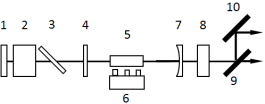
Figure 1. LD Side-pumped Nd: YAG Electro-optic Q-switched Extra-cavity Frequency-doubling Laser: (1) Total Reflector, (2) Electro-optic Q-switch Crystal Kd*P, (3) Polarizer, (4) Quarter-wave Plate, (5) Gain Medium Nd: YAG, (6) Ld Array, (7) Output Coupled Reflector, (8) Frequency-doubling Crystal Ktp, (9) Dichroic Mirror, (10) Mirror.
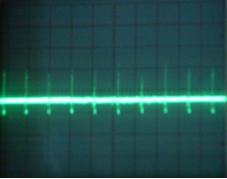
Figure 2. Waveform of the Pulse Train from the LD Side-pumped Nd: YAG Electro-optic Q-Switched Laser.
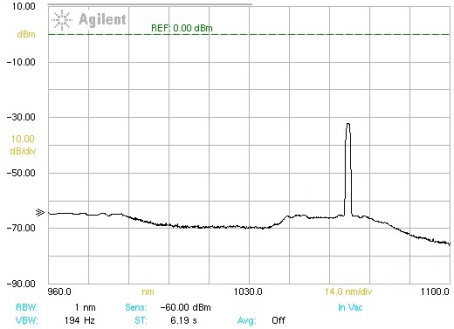
Figure 3. Output Spectrum of the LD Side-pumped Nd: YAG Electro-optic Q-switched Laser.




 Share This Article
 Twitter
 Linked In
 Facebook
 Copy
Copy Download